| |
In lugnet.trains, Mark Bellis wrote:
> In lugnet.trains, John Neal wrote:
> > A while ago, some were asking for details as to how we "detailed" our
> > tracks, especially the curves and points. I had a lot of free time this
> > weekend, and I decided to get some pics taken (unfortunately, all of our
> > points are still packed at the clubhouse and so I didn't have one around to
> > shoot)
> >
> > Anyway, <http://www.brickshelf.com/cgi-bin/gallery.cgi?f=7051 these pics>
> > should give you a good idea how Ross did it. The secret is in making the
> > ballast the same color as the dark gray LEGO ties (sleepers), so that it all
> > "blends in" and you can't tell the difference between the two. I saw how
> > the GMLTC used "speckled" ballast, but the relative size of each "speckle"
> > (a 1x1 plate) was too large IMO to create a truly "random feel" to the
> > ballast and so I stuck with a uniform color, and added the black tiles to
> > create more of a realistic look for the track.
> >
> > The other secret is that every other 1x4 black tile "floats" on one end,
> > resting on the edge of a tie, and covering nicely the gap underneath it.
> > Again, it is hard to explain, but the pics pretty much speak for themselves.
> >
> > Once I retrieve a point, I'll shoot some pics-- even {I} haven't examined
> > them all that closely, as Ross handled that job, too. ({I} did all of the
> > straights:-))
> >
> > HTH,
> >
> > [JOHN]
>
> I've fed these ideas into my melting pot of track bed plans.
>
> I'm building 12-14 wide trackbeds for a new modular scenic layout. I began
> with the packs of grey and dark grey plates, one pack doing either one
> straight plus one curve or one switch point. Seeing the tile sleepers
> confirmed my suspicions that more detail was needed. However I initially
> thought that black sleepers on their own would be just like 16.5mm gauge
> track without the ballast, so I needed to work on that in order to show that
> the sleeper scheme was feasible for my new layout.
>
> I've been developing different shades of track bed and experimenting with
> different sleeper colours: grey = concrete, dark grey = steel, black = wood.
>
> In the first experiment I built 2-straight samples showing a range of grey
> shades with each colour of sleepers. From these I think the black tile
> sleepers go best with most shades of track bed, grey tile sleepers are good
> when the track bed is dark grey through to black, though solid black track
> bed is rarely found on the main line where concrete sleepers would most
> likely be on UK railways. Dark grey sleepers are OK with light grey ballast
> but tend to lose contrast more easily as the shade darkens. So 'black
> sleepers are most versatile' is the conclusion of the sleeper colour
> experiment.
>
> The second experiment was to try the sleeper shades with some tan in the mix.
> I've noticed that many UK track beds are not pure shades of grey, yet tan is
> not too rich a colour to introduce. I built 2-straight samples with each
> sleeper colour and the same range of shades but with 25% tan 1x1s (one every
> 4L along the track, adjacent rows offset by 2L). This gave a similar result
> to the first experiment but also showed that 12.5% is probably enough tan.
>
> The third experiment was to make a more extensive set of samples with black
> sleepers, to check that shades from light grey through dark grey to black
> work well.
>
> I began introducing the darker shades into the middle of the track, since oil
> and ash (from steam engines) is dropped in the middle and the darker shades
> tend to spread out from there. This trend was gleaned from a study of many
> photos in a UK railway magazine. In my samples, the darker shades spread out
> till the 4ft is all dark grey and the 6ft is still light grey. This
> continues to the ends of the sleepers and then black is introduced into the
> middle. There is always a dark grey plate between each black plate and each
> light grey plate so that the change of shade is not too sudden.
>
> I've built 22 1-straight pieces of different shades from light grey to black,
> with room for a few more as I missed out 3/4 black a couple of times. The
> idea is that clean, freshly laid ballast would be light grey all over but a
> yard with lots of ash would be black all over.
>
> The next stage will be to count the parts used for each 1-straight single
> shade sample in order to work out what I need to buy to build the layout with
> 560 straights and 200 curves!
>
> Mark
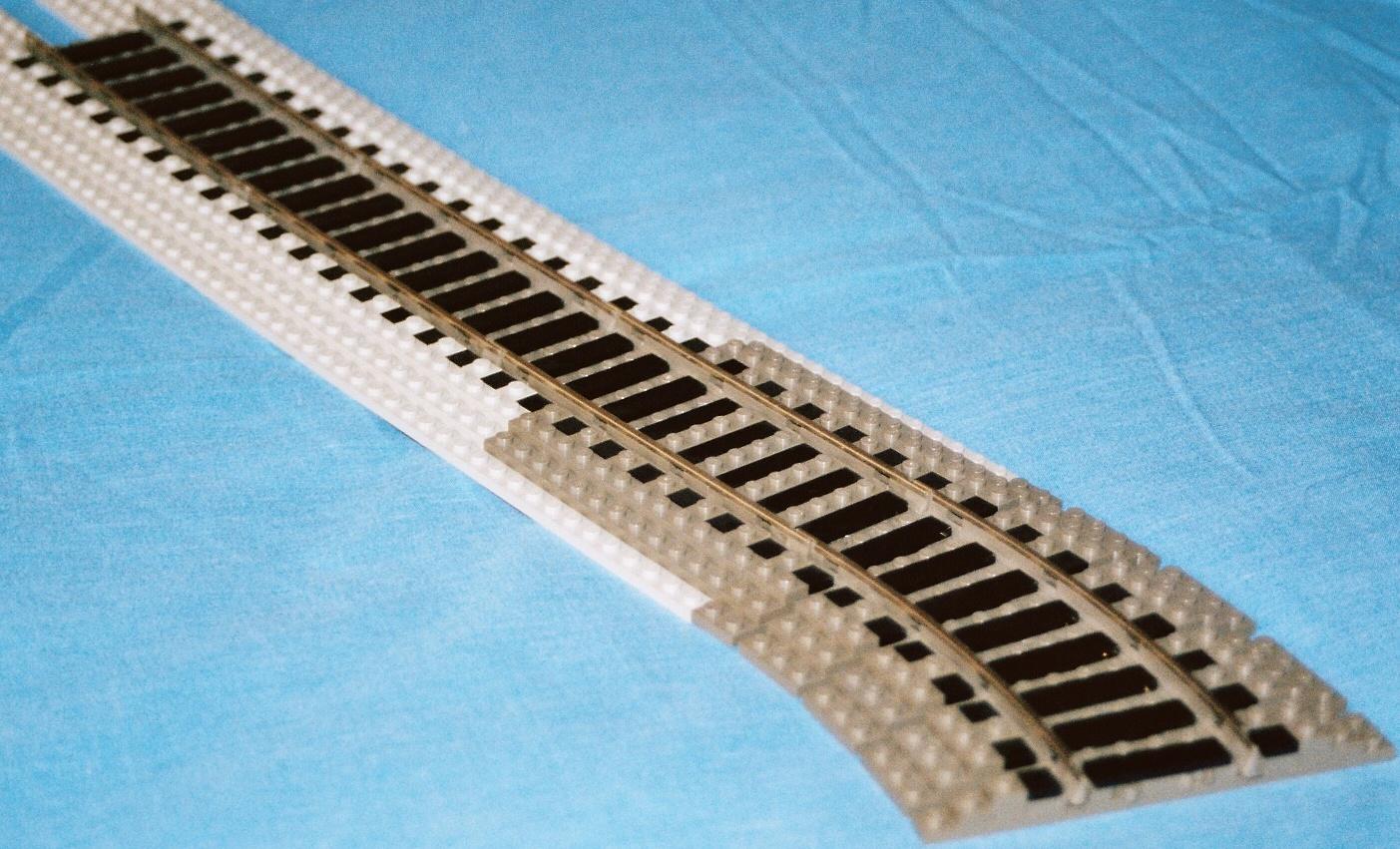
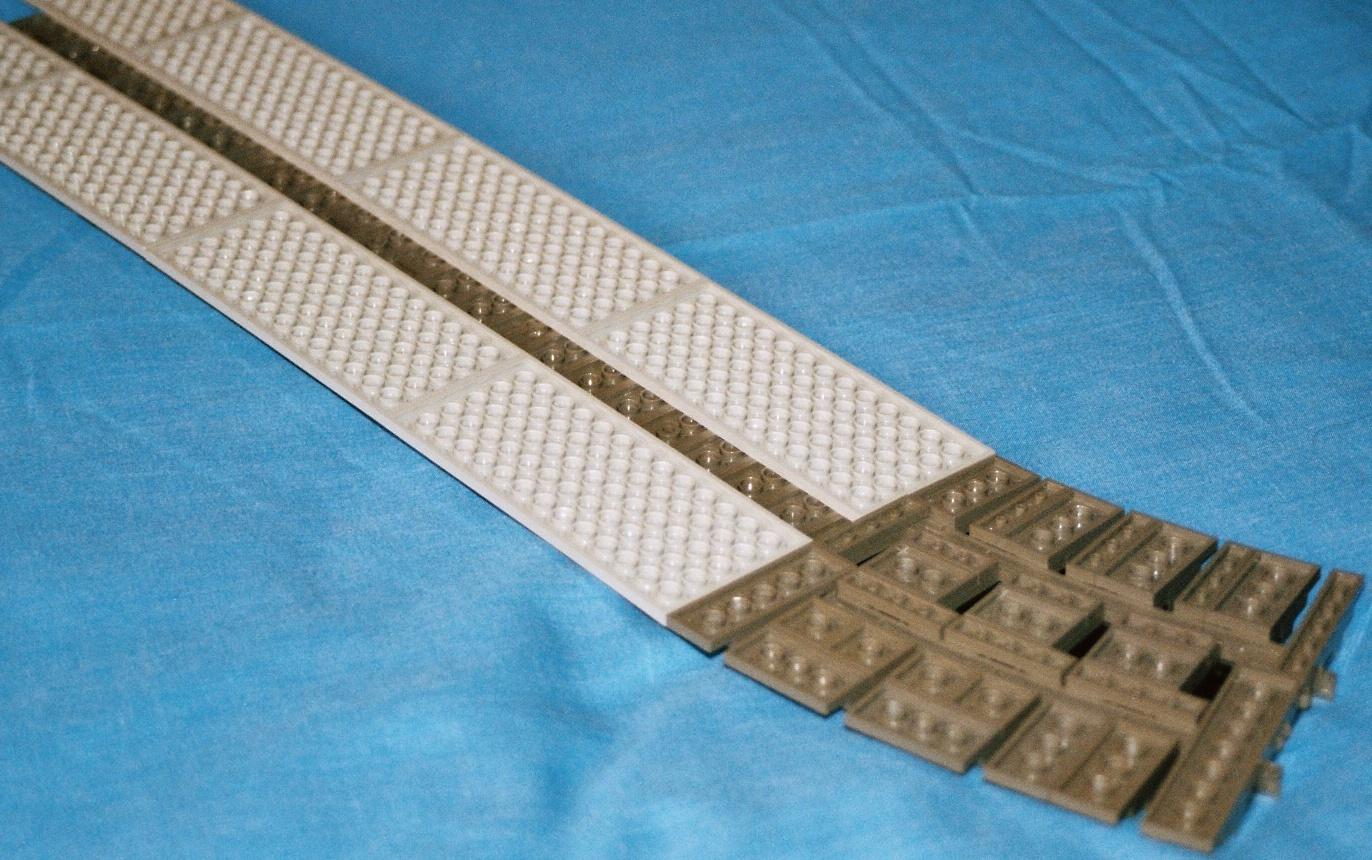
A couple of pictures of my evaluation of a wider TCLTC-style scheme, prior to my
experiments with sleeper colours and mosaic shading:
http://www.brickshelf.com/gallery/mbellis/Trains/Ballasting-Track/ballasted_track_14w_prototype_top.jpg
http://www.brickshelf.com/gallery/mbellis/Trains/Ballasting-Track/ballasted_track_14w_prototype_underside.jpg
I used this piece to test stuff like clearances for BBB wheeled locos,
feasibility of a wider track bed, basic shades of grey, interlocking of plates
on the curve and feasibility of parts procurement, all of which proved
successful.
One thing I would like to work out is how to ballast between the tiles in the
middle of the curve. We don't yet have log plates, which could otherwise do the
2 studs of widest radius between the rails.
Has anyone else developed this scheme any further?
Mark
|
|
Message is in Reply To:
 | | Re: TCLTC Sleepers with Wide Mosaic Track Bed
|
| (...) I've fed these ideas into my melting pot of track bed plans. I'm building 12-14 wide trackbeds for a new modular scenic layout. I began with the packs of grey and dark grey plates, one pack doing either one straight plus one curve or one (...) (21 years ago, 14-Oct-05, to lugnet.trains, FTX)
|
9 Messages in This Thread:


- Entire Thread on One Page:
- Nested:
All | Brief | Compact | Dots
Linear:
All | Brief | Compact
|
|
|
|